
Nobody can promise a review or a new application will succeed. The regulator, or the tribunal on review, makes the decision. This is general information, not legal advice. If you’re unsure about your rights, get legal advice.
First steps, whatever your state
- Find the date on the decision letter. Every review deadline below runs from the decision, or from when you were notified of it.
- Read the reasons. They tell you which requirement wasn’t met, such as experience, qualifications, referees, financials or fitness and propriety.
- Check your review rights. The letter should say whether the decision can be reviewed and where.
- Keep everything. You’ll need the letter for any internal review or tribunal application.
Queensland (QBCC)
Common reasons for refusal
To hold a QBCC licence you need the technical qualification and experience for the class, you must meet the minimum financial requirements (MFR), and you must be a fit and proper person. The QBCC’s application guides cover the first two.
For fit and proper, the QBCC considers your honesty and integrity, any failure to meet commercial or statutory obligations, Tier 1 defective work, unpaid QBCC infringement fines with SPER, interstate or New Zealand licences that were cancelled or suspended, and other relevant factors such as criminal history. If the QBCC isn’t satisfied, it issues a show cause notice giving you at least 21 days to respond before it decides.
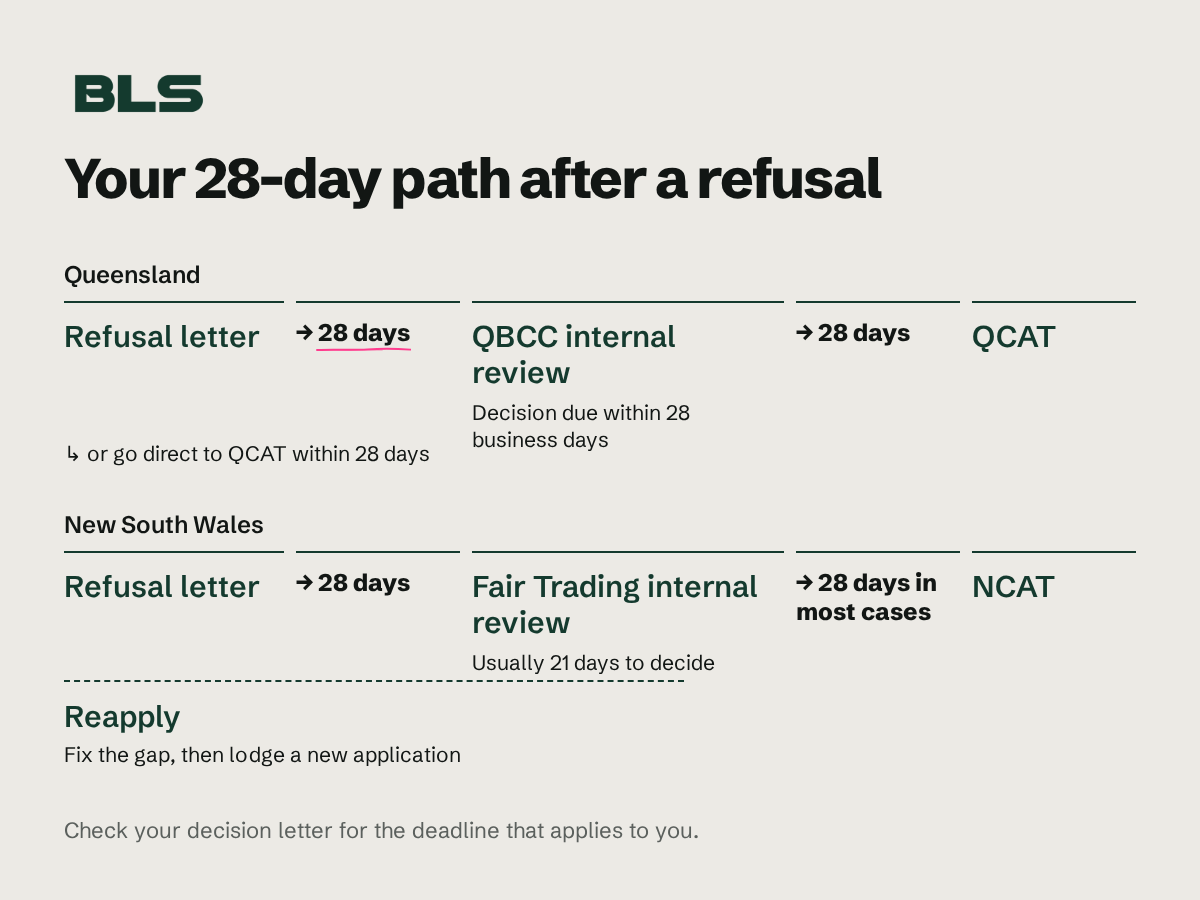
Internal review: 28 days
Refusal of a licence application is a reviewable decision. You have 28 calendar days after you’re given notice of the decision, or otherwise become aware of it, to apply to the QBCC’s Internal Review Unit on the approved form. Your application should cover:
- the original case number and the date of the decision
- the name of the original decision maker
- why you believe the decision is wrong, or what information was missed
- what you’d like to happen
Late applications may be accepted if you give sufficient justification for the delay. Applications are acknowledged within 2 business days. An internal review decision can’t be re-reviewed by the QBCC, but it can go to QCAT.
QCAT: 28 days
You can apply to QCAT within 28 calendar days of either the original decision or the internal review decision. If you apply to QCAT before or during the QBCC internal review, the internal review lapses. Include the decision letter with your application. QCAT has a form for asking to apply outside the time limit (Form 42).
Victoria (BPC)
The Building and Plumbing Commission (BPC) is Victoria’s building regulator. It was formerly the Victorian Building Authority (VBA).
Common reasons for refusal
The BPC must be satisfied that you meet the registration requirements for the class: the prescribed or an equivalent qualification, enough relevant experience (paid, supervised, across technical, supervisory and contractual work, in the last 7 years), fitness and propriety and, for some classes, the right insurance. A Domestic Builder application also needs a Technical Referee Report on the correct form from a referee registered in the same class or a higher one.
If you sit the BPC exam and don’t meet the standard, the BPC says your application is likely to be refused. To sit again, you’d need to lodge a new application.
Internal review: 28 days to apply, 28 days to decide
Refusal to grant registration is a reviewable decision. You apply on the BPC’s Application for Internal Review Form within 28 days after the day you’re given notice of the decision, and you must state your grounds in full. The BPC may extend the time if you apply on its extension of time form.
The internal review period is 28 days after you apply (Building Act 1993, section 185D(4)). The BPC must give you a notice of its review decision, with reasons and your VCAT rights, within that period.
In most cases you must seek internal review before going to VCAT. Exceptions include decisions made by the Chief Commissioner or CEO, and suspensions and cancellations.
VCAT: 14 or 28 days
For a decision about a building practitioner, VCAT says you must apply:
- within 14 days if you originally applied for internal review
- in any other case, within 28 days after the reviewable decision or review decision is made
VCAT can extend the time limit if you explain on the form why you were late. It can affirm, vary or replace the decision. Bring a copy of the decision letter. You may have to pay a fee, and fee relief is available.
New South Wales (Building Commission NSW)
Common reasons for refusal
Building Commission NSW assesses your qualifications and experience (for general building work, at least 2 years, mostly within 10 years, supervised and verified by a holder of a qualified supervisor certificate or contractor licence (Q)) and your fitness and propriety. That includes financial and criminal history, disciplinary and compliance actions, complaints and tribunal orders. It says applications may be refused for several reasons, and that it’s an offence to make a false statement or leave out information on an application.
Internal review: 28 days
Submit your internal review application within 28 days of receiving the decision. A review officer who wasn’t involved in the original decision assesses whether it was fair and correct. It isn’t a reprocessing of your application. In most cases the Reviewable Decisions Unit has 21 days to complete the review.
NCAT: generally 28 days
Generally you need to seek internal review before going to NCAT. If you disagree with the internal review decision, or haven’t had a response within 21 days, you can apply to NCAT, generally within 28 days of being notified of the internal review decision. Check the relevant legislation for the exact time limit.

Review or reapply?
A review asks whether the decision was right on the information the regulator had, or should have had. A new application lets you start again with stronger evidence. Some people do both. Which is right depends on your reasons letter, and legal advice can help if you’re unsure.
How to fix the gaps
Most refusals come down to evidence that didn’t show the regulator what it needed. Common fixes:
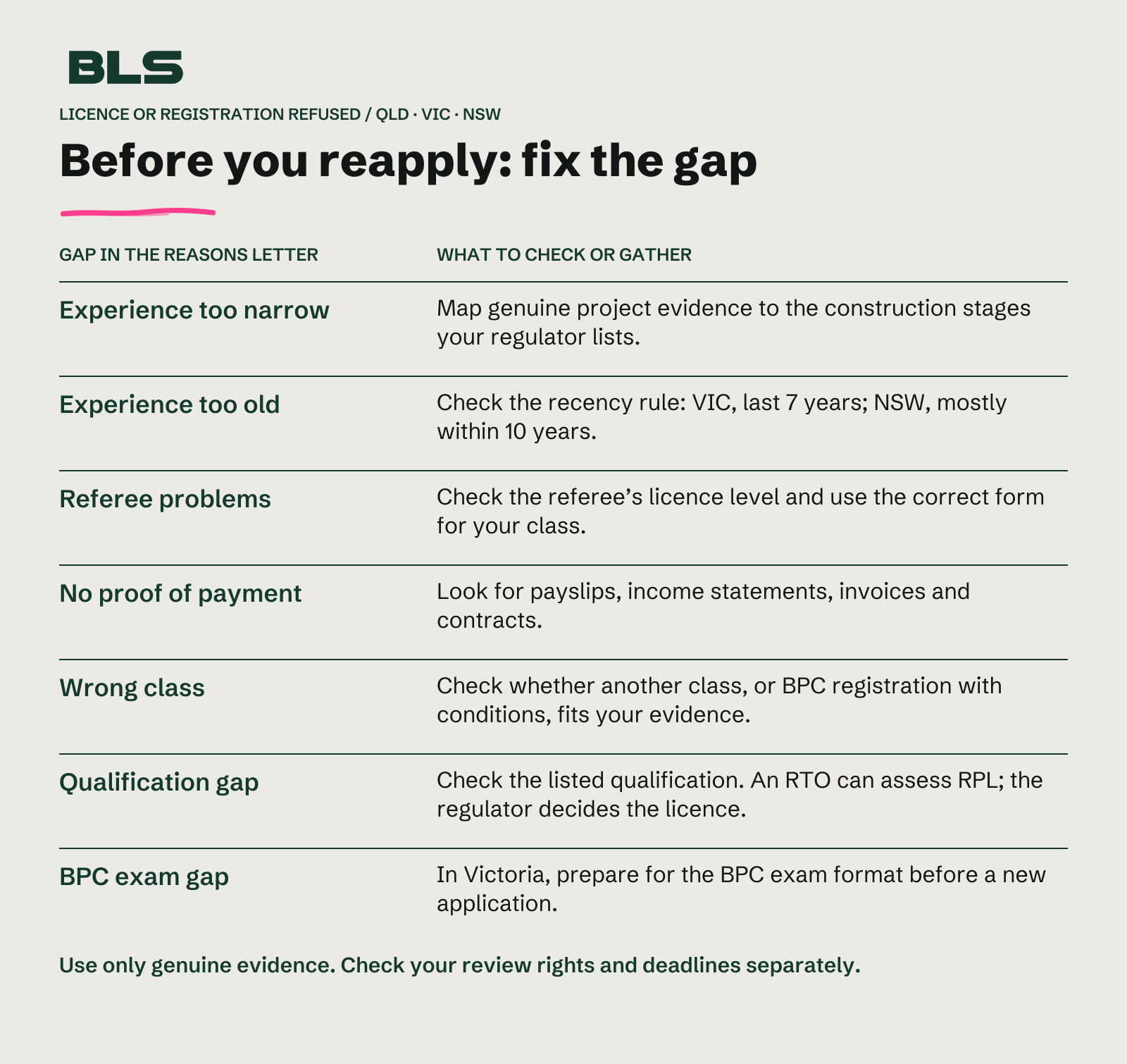
- Experience too narrow? Map your jobs against each stage the regulator lists (for example, the QBCC’s base, frame, enclosed and fit-out stages) and find the stages you can genuinely show.
- Experience too old? Check the recency rule: VIC is the last 7 years, NSW is mostly within 10 years.
- Referee problems? Check the referee’s licence level and that the right form was used for your class.
- No proof of payment? Look for payslips, income statements, invoices and contracts.
- Wrong class? Some classes, or a BPC registration with conditions, may better match the experience you can show.
- Qualification gap? Check whether your qualification is the listed one. An RTO can assess RPL, but the regulator still decides the licence.
- Exam? In VIC, prepare for the BPC exam format before a new application.
Never fill a gap with anything that isn’t genuine. All three regulators treat false or misleading information seriously.
Get your evidence right this time
BLS can go through your refusal reasons with you and help you work out what’s missing. We help you back-track your work history, find where your proof sits, check your referees and class, and prepare the forms properly this time. In Victoria, we coach you for the BPC exam. The regulator or tribunal makes the decision.
Related guides by state:
- QLD: Builder licence QLD: what to have ready, QBCC builder qualification and experience
- VIC: Victorian builder registration: can your experience support it?, BPC builder exam books
- NSW: Builder licence NSW: application checks
Or see the state licence pages: QLD, VIC, NSW
FAQ
My QBCC licence was refused. What now?
Read the reasons and note the date. You have 28 calendar days to apply for QBCC internal review, or to go to QCAT. Applying to QCAT before or during the internal review makes the internal review lapse.
My builder registration was refused in Victoria. Can I appeal?
Yes. You can apply for BPC internal review within 28 days of being notified, and the BPC has 28 days to decide. If you still disagree, you have 14 days to apply to VCAT.
Can I apply to the tribunal straight away?
In QLD, yes, within 28 days, but it ends any internal review. In VIC and NSW, you generally need to seek internal review first.
What if I’ve missed the deadline?
The QBCC, BPC, QCAT and VCAT can each consider late applications if you explain the delay. There’s no guarantee they’ll accept one.
Can I just reapply instead?
Yes, you can lodge a new application. In VIC, if you failed the BPC exam, a new application is the only way to sit it again. Fix the gaps in your evidence first.
Official sources
Checked 24 October 2026.
Queensland
- QBCC: Review of a QBCC decision
- QBCC: What can be reviewed?
- QBCC: Apply for an internal review
- QBCC: Fit and proper
- QCAT: QBCC reviews
Victoria
- BPC: Internal review (hosted on the BPC’s former domain)
- BPC: Building practitioner registration
- BPC: Building exams FAQ
- VCAT: Building Act 1993 reviews
- VCAT: Application for review of a BPC decision
New South Wales