
The regulator makes the final decision on every application. This is general information, not legal advice.
Quick answer: years of experience by state
| State | Regulator | Example class | Experience the regulator lists |
|---|---|---|---|
| QLD | QBCC | Builder – Low Rise | 2 years with a carpentry or bricklaying/blocklaying trade qualification, otherwise 4 years |
| VIC | BPC | Domestic Builder (Unlimited) | At least 3 years, gained in the last 7 years |
| NSW | Building Commission NSW | General building work | At least 2 years, with most of it gained within 10 years of applying |
You also need the qualification the regulator lists for that class. Years alone don’t get you a licence.
What counts as building experience
The details differ, but all three regulators look for the same things:
- The right kind of work. Experience across all stages of a build, not just one trade or one stage.
- Supervision and responsibility. QLD expects you to have been the full-time site supervisor. VIC wants technical, supervisory and contractual work. NSW wants the capacity to do, coordinate and supervise general building work.
- Supervised and verified. Your referee generally needs to hold a licence or registration at the right level (details in each state section).
- Paid work. VIC and NSW both say the experience must have been paid. Owner-builder work is excluded in QLD and VIC.
- Recent work. VIC wants the last 7 years. NSW wants most of it within 10 years.
Evidence that can back it up
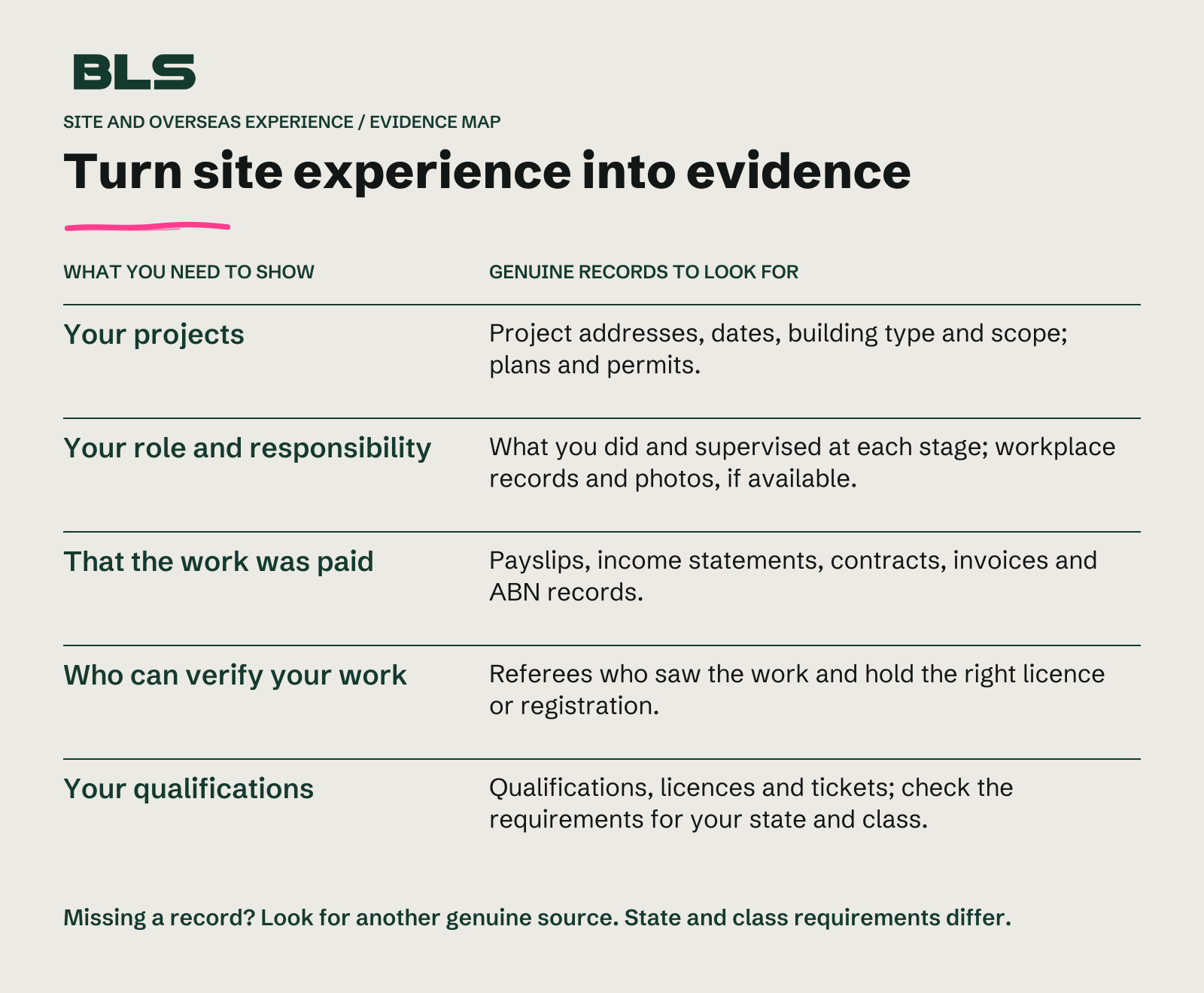
Most tradies don’t photograph every job or keep a daily diary. That’s normal. Your proof is usually spread across places like these:
- project addresses, dates, building type and scope
- your role at each stage: what you did and what you supervised
- payslips, income statements, contracts, invoices and ABN records
- building permits, plans, inspection records and insurance certificates that name the builder
- photos and workplace records, if you have them
- qualifications, licences and tickets
- referees who saw your work and hold the right licence
The evidence has to be yours and it has to be true. If a record doesn’t exist, look for another genuine source, such as a payslip, a permit or a referee.
RPL: how it fits in
Recognition of prior learning (RPL) is an assessment-only process. A registered training organisation (RTO) assesses the skills you’ve built through work, training or life experience against a qualification’s requirements. Depending on what your evidence shows, you might get full or partial credit, or need gap training (ASQA).
Typical RPL evidence includes work samples, training records and employer references (ASQA).
What RPL does and doesn’t do:
- The RTO decides the RPL outcome. ASQA expects real assessment by qualified assessors. ASQA has taken action against providers that issue qualifications without proper assessment.
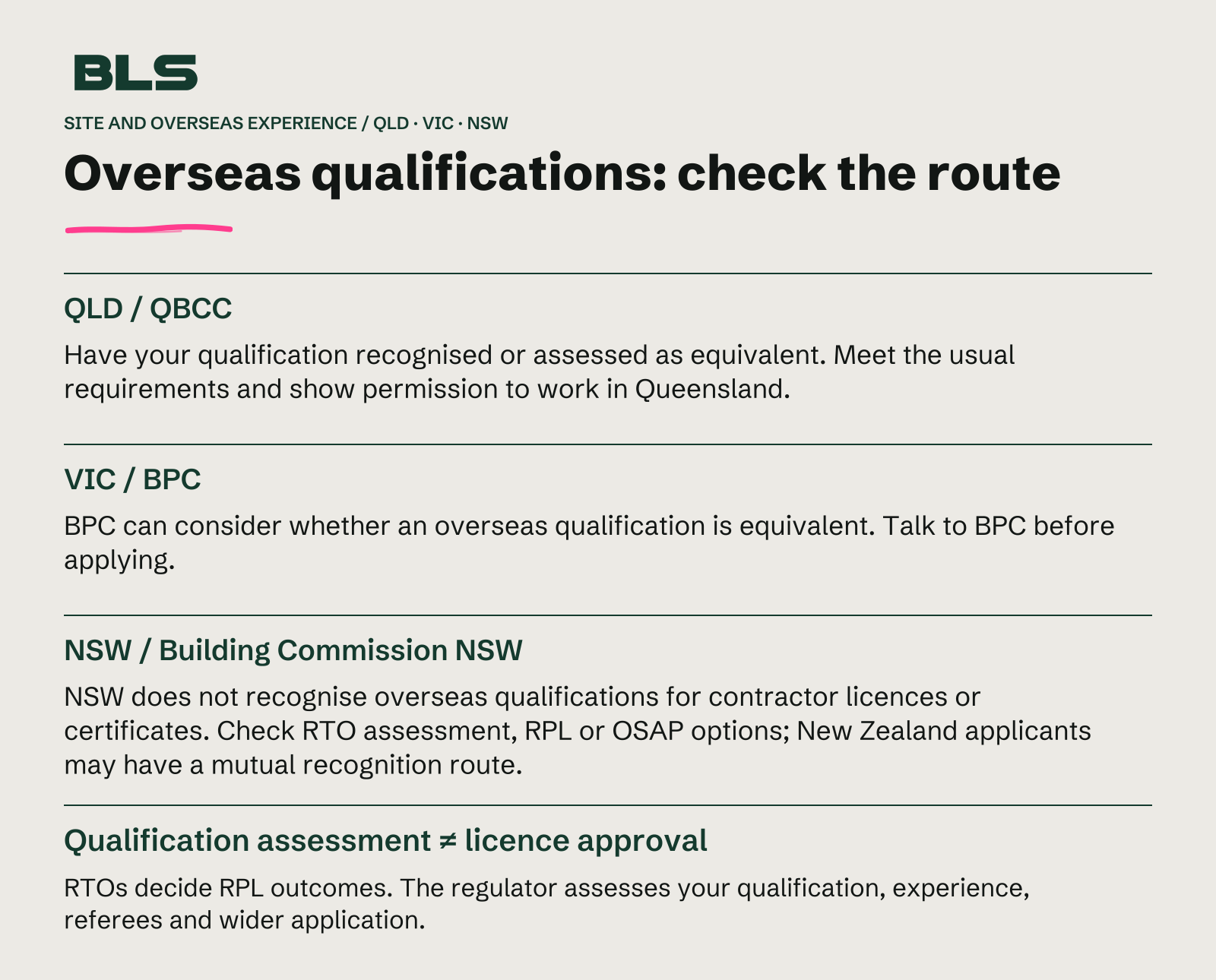
- RPL can give you a qualification. It doesn’t give you a licence. The QBCC, BPC or Building Commission NSW still assesses your experience, referees and everything else.
- Check the qualification first. Make sure the qualification you’re pursuing is the one your state lists for your class. For example, the Certificate IV in Building and Construction is not a prescribed course for Victorian domestic builder classes.
Queensland (QBCC)
Qualification and years
For Builder – Low Rise, the QBCC lists a Certificate IV in Building and Construction (CPC40120) or a qualification it accepts as equivalent. You also need:
- 2 years’ experience in the scope of work if you hold a carpentry or bricklaying and blocklaying trade qualification, or
- 4 years if you don’t. Under the legislation, only those trade qualifications reduce the time.
What counts
- The QBCC expects your primary role to have been the full-time site supervisor, supervising work through the different stages and subtrades.
- You list work across each stage on the evidence of experience form: base, frame, enclosed, fit-out and project administration.
- Class 10 work (sheds, garages) can be part of your background but shouldn’t be relied on alone. You need evidence covering all stages of Class 1 work (houses).
- Owner-builder work should not be used.
- Referees should hold a licence or qualification at the same or a higher level than the licence you’re applying for. The QBCC may also consider a referee in a supervisory or managerial role at the company.
- For experience gained in Queensland, the QBCC recommends getting a site supervisor licence first. It isn’t a legal requirement, but without one the QBCC relies more heavily on referees and supporting information.
Overseas-trained carpenters and builders
You must meet all the usual requirements, show permission to work in Queensland (citizenship, permanent residency, or a visa or ImmiCard with work rights), and have your qualification recognised or assessed as equivalent. The QBCC considers whether an overseas course matches the Australian Qualifications Framework and Australian building standards. It says some RTOs may be able to issue a qualification through RPL.
For interstate and New Zealand experience, the QBCC asks for proof that your referee was the responsible builder, such as insurance policies or building permits. It’s worth having the same kind of proof for overseas jobs. Ask the QBCC what it will accept for your country.
NSW builders moving to Queensland
If you hold a current NSW builder licence, you can apply under mutual recognition. The QBCC can only issue an equivalent licence, and any conditions carry over. NSW builder licences only cover domestic work, so the QBCC limits the Queensland licence to BCA Classes 1a, 2, 4 and 10. For commercial work, or if you hold a NSW supervisor licence, the QBCC says a full Queensland application may be more appropriate. Keep your NSW licence active until the QBCC approves your application. Mutual recognition doesn’t apply to companies.
Victoria (BPC)
Qualification and years
For Domestic Builder (Unlimited), the BPC lists:
- a prescribed qualification, such as the Diploma of Building and Construction (Building) (CPC50210 or CPC50220) or a named construction management degree
- at least 3 years of practical experience
The Certificate IV is not a prescribed course for any domestic builder class. The BPC will consider it as part of its wider assessment, and you may be asked to sit an additional BPC exam.
What counts
The BPC says your experience should be:
- supervised by a registered building practitioner
- paid, as an employee or contractor
- across technical, supervisory and contractual work
- for at least the minimum years
- gained in the last seven years
Keep records of employment and contract work, because the BPC may ask for proof the work was paid. You’ll need a Technical Referee Report from a Domestic Builder registered in the same class or a higher one, on the correct form for that class. The BPC can also ask you to sit an exam. The BPC accepts Domestic Builder (Unlimited) applications with conditions that limit the scope of work, so you can apply at the level your experience supports.
Overseas qualifications
Victorian law lets the BPC register someone whose qualification it considers equivalent to the prescribed one, alone or together with further knowledge, experience or an exam. VCAT has called this the “path less travelled”. The BPC still expects experience close to 3 years in the last 7. Talk to the BPC before you apply.
Coming from NSW
NSW takes part in Automatic Mutual Recognition (AMR). You may be able to work in Victoria on your NSW registration by completing the BPC’s online Automatic Deemed Notification form before you start any work. The alternative is to apply for a Victorian registration through Mutual Recognition. Check with the BPC which route fits your occupation.
New South Wales (Building Commission NSW)
When you need a licence
In NSW you need a licence or certificate for any residential building work, including general building work worth more than $5,000 in labour and materials (including GST).
Qualification and years
For general building work, you need one of the approved qualifications and at least 2 years’ relevant industry experience in a wide range of building construction work. Most of that experience must have been gained within 10 years of your application.
What counts
Building Commission NSW checks whether:
- your experience fits one of its four defined types of experience
- it was supervised and verified by the holder of a qualified supervisor certificate or individual contractor licence (Q) in general building work
- most of it was gained within 10 years of applying
- the work at each site is relevant
You need practical experience across all stages of construction, showing you can do, coordinate and supervise residential building work. Your supervisor completes the Referee Statement Form – General Building Work (Builder) (HB040), confirming the work was paid. You apply in person, with a National Police Check no more than 4 months old, your original qualifications and details of your employment and experience.
Overseas-trained applicants
NSW does not recognise qualifications from outside Australia for contractor licences or certificates. Instead you may be able to:
- get a skills assessment or RPL through an RTO
- use the Offshore Skills Assessment Program (OSAP). For a full contractor licence or qualified supervisor certificate, this means Australian-context gap training, a period of supervised employment and the relevant Certificate III
- apply under the Trans-Tasman Mutual Recognition Arrangement if you’re from New Zealand
Where applications usually fall short
- experience that’s too old (VIC: last 7 years; NSW: mostly within 10 years)
- experience that’s too narrow: one stage or trade, or on the tools only with no supervision
- referees without the right licence level, or the wrong referee form
- no proof the work was paid
- owner-builder work counted as experience
- relying on sheds and garages instead of houses (QLD)
- a qualification that isn’t the one listed for the class
How BLS helps
You bring the experience. BLS helps you show it properly. We:
- check which licence or registration fits what you do now
- review the qualifications, projects, licences and referees you already have, and tell you what’s missing before you lodge
- help you back-track your work history and work out where your proof sits, even if you never kept a diary or photos
- prepare you for the forms, so you know what each part is asking for. You complete and lodge your own application
- coach you for the BPC exam if you’re applying in Victoria
- check whether your current licence may be recognised interstate
RTOs decide RPL outcomes. The QBCC, BPC or Building Commission NSW decides your licence or registration.
Related guides by state:
- QLD: Builder licence QLD: what to have ready, QBCC builder qualification and experience, Can RPL help you get a builder licence?
- VIC: Victorian builder registration: can your experience support it?, BPC builder exam books
- NSW: Builder licence NSW: application checks
Or see the state licence pages: QLD, VIC, NSW
FAQ
How many years’ experience do I need for a builder licence?
In QLD (Builder – Low Rise), 2 years with a carpentry or bricklaying trade qualification, or 4 years without one. In VIC (Domestic Builder Unlimited), at least 3 years in the last 7. In NSW (general building work), at least 2 years, with most of it in the last 10 years. You need the listed qualification as well.
Can an overseas carpenter get a builder licence in Australia?
Possibly, but there’s no shortcut. In QLD you must meet the normal requirements and have your qualification recognised or assessed as equivalent. NSW doesn’t recognise overseas qualifications, so you’d need an Australian qualification through an RTO, RPL or OSAP. In VIC, the BPC can consider whether an overseas qualification is equivalent.
Can RPL get me a builder licence?
No. RPL can lead to a qualification, and an RTO decides it. The regulator then decides whether your qualification, experience and referees meet the licence requirements.
What counts as building experience for a licence?
Paid, supervised work across all stages of a build, at the level of the class you want, confirmed by a suitably licensed referee. Owner-builder work doesn’t count in QLD or VIC.
Does site supervisor experience count?
It can, if it covers supervising the whole job, every stage and the different trades, for the required time. In QLD, the QBCC expects you to have been the full-time site supervisor.
I didn’t keep photos or a diary. Can I still prove my experience?
Often, yes. Payslips, tax records, contracts, invoices, permits, insurance certificates and referees can all show what you did and when. They have to be genuine and your own.
Can I use my NSW licence in Queensland?
Yes, if it’s current, through mutual recognition. The QBCC limits the licence to BCA Classes 1a, 2, 4 and 10.
Official sources
Checked 24 October 2026.
National
- ASQA: Credit transfer and recognition of prior learning
- ASQA: Recognition of prior learning (risk priority)
Queensland
- QBCC: Builder low-rise application guide (PDF)
- QBCC: Builder – low rise
- QBCC: Evidence of experience form (PDF)
- QBCC: Interstate or overseas applicants
Victoria
- BPC: Building practitioner registration (hosted on the BPC’s former domain)
- BPC: Domestic builder
- BPC: What is domestic building work?
- BPC: Automatic Mutual Recognition
- BPC: Mutual Recognition for building practitioners
- VCAT: Turcarolo [2025] VCAT 1135
New South Wales