
Many Victorian tradies have been delaying their builder registration application because the old interview process felt uncertain. You’d prepare for weeks, sit in a room with assessors and not know if your answers would be good enough. That process created anxiety, and it left room for inconsistency.
The BPC removed the interview to reduce bias and protect against corruption. Now you’re answering questions against a standard, not being judged by a person in a room. For experienced builders who know their work, this change removes a lot of the guesswork.
What changed from the interview
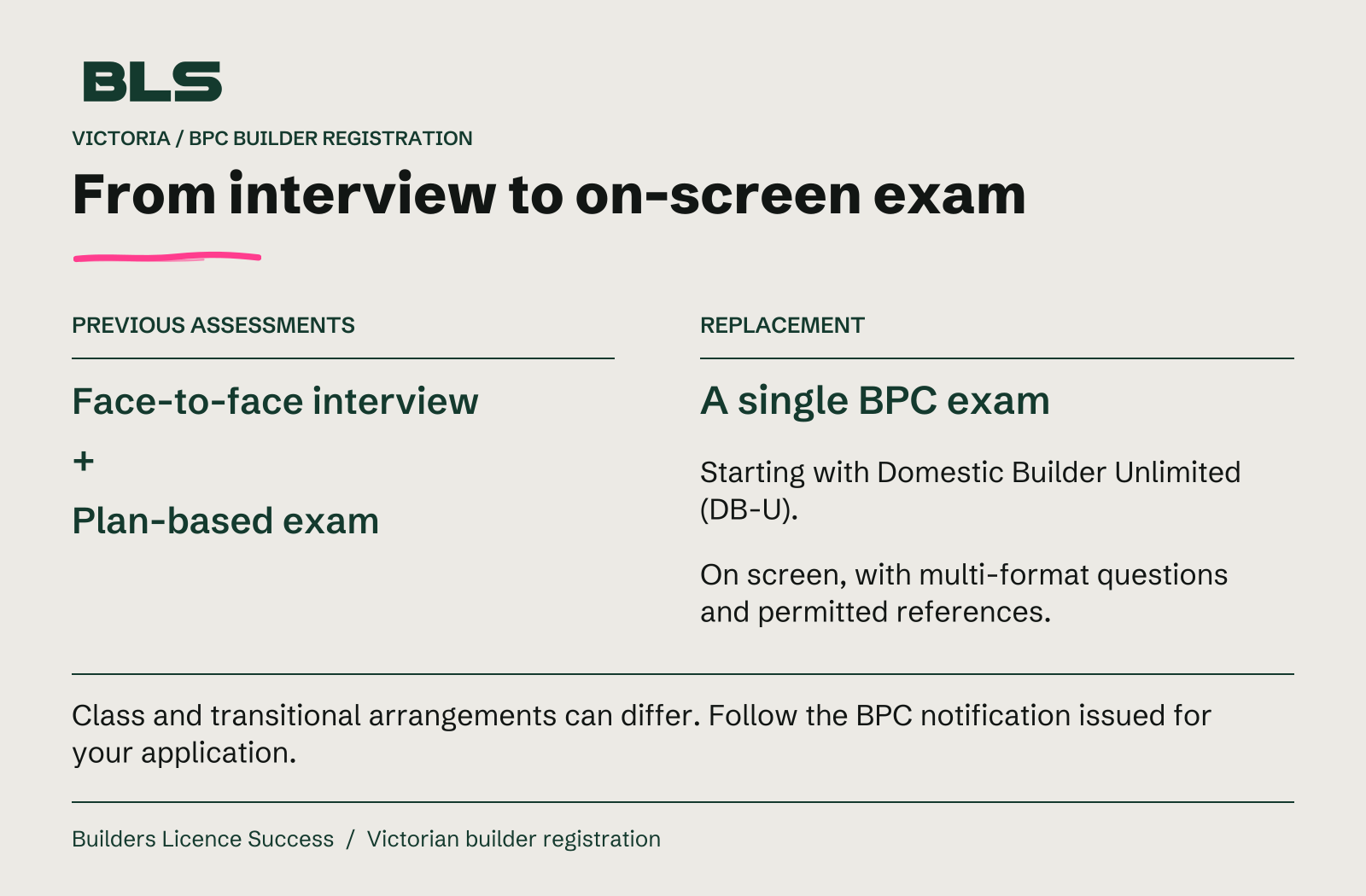
The old assessment (before January 2026)
For Domestic Builder (Unlimited), applicants faced:
- a face-to-face interview with BPC assessors
- a separate plan-based exam
- 40 supporting documents
The new assessment (from January 2026)
The BPC introduced a reformed process starting with Domestic Builder (Unlimited):
- one exam, tailored to your registration class
- no interview
- 7 supporting documents
The BPC designed the exam with the Australian Council for Educational Research (ACER) and said it would extend the new approach to other building and plumbing registration classes over the following months. It planned to bring the reduced paperwork to all domestic and commercial builder classes by the end of March 2026.
The BPC’s registration page still says that depending on the class, you may be required to complete an exam or an interview. Your own notification from the BPC will tell you which assessment applies to your application.
Before assessment
- 01
Confirm your class
Check your assessment invitation.
- 02
Check permitted references
Confirm sources and editions with the authority.
- 03
Check access
Free official sources. Paid reference access where required.
Use the official links alongside this guide.
Which classes sit the new exam
The BPC began with Domestic Builder (Unlimited) in January 2026 and said all exams would be available online by June 2026. The classes listed on the BPC’s building exams page include:
- Domestic Builder (Unlimited)
- the limited Domestic Builder classes: carpentry, framing, footings and slabs, cladding, roof tiling, pools and spas, retaining walls, waterproofing and more
- Commercial Builder classes
- Demolisher classes
- Building Inspector (pool safety)
- Building Designer
You don’t opt in. The BPC emails you if you need to sit an exam, and the timeframe you have to complete it.
What the BPC exam is like
Format and questions
The exam uses multi-format questions: multiple choice, drag and drop, reorder, true/false and image select. The questions are randomised and changed frequently, so every exam is different.
It’s delivered through Janison-Proctortrack with proctoring. Your ID check during onboarding, the scan of your room and the exam itself are recorded through your webcam and microphone, along with your computer desktop.
Length: 1 or 2 hours
The BPC sets the exam length based on the class you’re applying for and factors such as your qualifications, building experience, employment history and technical referees. Your notification letter confirms whether you have 1 or 2 hours.
When time runs out, your answers submit automatically. You can’t go back afterwards.
Questions and pass mark
The BPC doesn’t publish a question count or a fixed pass mark. It says it sets a passing standard that reflects minimum competence, every exam version is held to the same standard, and the pass mark adjusts to the difficulty of the questions.
HIA reports that the Domestic Builder (Unlimited) exam has 100 questions drawn from a pool of about 1,000, with two hours to complete it, and that a shorter 50-question, 60-minute exam is available for certain applicants.
Open book with strict conditions
The exam is open book, but with rules. Sitting online, you can only use the permitted reference materials inside the exam interface. Your own notes, printed material, search engines and AI tools such as ChatGPT are not allowed.
For a transitional period, the BPC is letting applicants who have their own hard copy reference materials sit the exam in person at a BPC location. The BPC says hard copy materials are allowed for in-person exams. Confirm with the BPC what you can bring.
To use Australian Standards during the exam, you need your own active subscription or purchased online version, and your login credentials ready. The BPC expects you to arrange this yourself. It’s a real cost on top of your application fee.
Sitting the exam: in person right now
The BPC’s exams page says building practitioner online exams are being conducted in person at BPC Head Office while technical issues are resolved, and that affected applicants are being contacted directly. This notice was last updated 28 August 2026 and was still there when checked on 24 October 2026.
In person, you sit on a BPC-provided laptop and a BPC supervisor helps you get started. It’s still an on-screen exam with the same format and rules.
If you’ve been preparing to sit at home, check your email and confirm your arrangements before exam day. This may change, so contact the BPC on 1300 067 088 or [email protected] if you’re unsure where you stand.
Before exam day
Allow time for onboarding
Before you can sit, you go through onboarding in Janison-Proctortrack: a system check, a face scan, government photo ID (licence or passport), and desk and room scans. Approval usually takes 8 to 24 hours, but the BPC says to allow up to three days.
You can’t start the exam until onboarding is approved. Applicants who leave it to the last minute run out of time.
Check your computer
If remote exams resume, you’ll need:
- a laptop or desktop with keyboard and mouse, webcam, microphone and high-speed internet
- administrator rights to install Proctortrack (a locked-down work laptop can fail)
- not a tablet, Chromebook or phone
If you don’t have a suitable computer, email the BPC to arrange an alternative.
Need a different date?
Email [email protected] within 3 days of your notification. New dates should generally fall within two weeks of the timeframe you were given, unless there are extenuating circumstances, and you may need to provide evidence.
If you decide not to proceed, tell the BPC at least 48 hours before your scheduled exam.
Request adjustments early
If you need reasonable adjustments to how you sit the exam, contact the BPC within three business days of receiving your exam invitation, by email or on 1300 067 088.
The exam rules
During the exam you must
- stay plugged into power
- hold a stable internet connection
- keep webcam, speakers and microphone on
- stay seated and in view of the camera (if you stand to stretch, stay in frame)
- be alone in the room
- have only one browser open
On your desk you may have
A drink, reading glasses and medication such as an inhaler or pain relief. That’s it. Everything else comes off the desk.
Not permitted
- talking, including reading questions out loud to yourself
- help from anyone else
- printed material, including notes you’ve prepared (online sittings; see below for in-person)
- Google, Bing or any search engine
- any AI tool such as ChatGPT
- phones, watches, earbuds, headphones, tablets, electronic notebooks
- your own calculator (there’s one built into the exam)
- a second monitor
- recording, screenshotting or writing down questions, during or after
If you breach the rules, you may be required to re-sit in person, undergo further assessment, or have your application refused.
Results and what happens if you fail
You won’t see a result on screen. The BPC emails it to you. If you pass, the email tells you the next steps in your assessment.
If you don’t meet the required standard, your application for registration is likely to be refused, and you’ll be notified in writing. You can seek an internal review of that decision.
To sit again, you need to lodge a new application for registration. It isn’t a free re-sit. That’s the case for preparing properly the first time rather than treating the exam as something you’ll figure out on the day.
If you missed the exam window and there were exceptional circumstances, you can ask for another opportunity. The BPC may require written evidence.
Is a Cert IV enough to get registered?
Not on its own. The BPC says the Certificate IV in Building and Construction (Building) is not a prescribed course for any registration class under the Building Regulations 2018. It partly meets the knowledge requirements for domestic builder classes, and applicants without the prescribed course for their class may be asked to sit an additional BPC exam.
For Domestic Builder (Unlimited), the prescribed qualification is a Diploma of Building and Construction (Building) (CPC50210 or CPC50220), or one of two specified construction management degrees. The BPC also asks for at least 3 years of practical experience.
The BPC says experience should be supervised by a registered building practitioner, paid (employment or contracting), cover technical, supervision and contractual work, and have been gained within the last seven years. It says not to rely on owner-builder experience or experience from training courses, which it may disregard.
How to prepare for the BPC exam
The exam tests more than whether you’ve collected the books. You need to find the right provision under time pressure, and many experienced builders struggle with the online navigation rather than the technical content itself.
Know your permitted references
Start with the exact class on your exam invitation. Use the BPC builder exam books guide to build your list, then confirm every item against the current BPC permitted assessment reference materials page.
Don’t buy a generic builder book pack. The permitted references depend on your class, and the list can change.
Practise finding information fast
Learn where information lives in the Acts, regulations, NCC and Standards. Learn the contents pages, headings and document structure. Practise on the approved websites rather than saved PDFs, so navigation and logins aren’t new on exam day.
Get your Standards access sorted early
If Australian Standards are listed for your class, you need your own online access. Sort it out early, test the login and make sure access will still be active on exam day. You have to enter those credentials mid-exam.
Check shortly before the exam
The BPC’s exam arrangements, permitted references and editions can change. Recheck your invitation and the live BPC pages shortly before the assessment.
Why tradies are anxious about the exam
Nathan, one of BLS’s advisors who takes phone enquiries, hears this anxiety every day. He says: “They call me, ‘Oh man, I’m so upset. I don’t understand this, don’t understand.’ I say, ‘Hey it’s okay. I can promise you, by the time you hang up the phone, you will have every question answered and it will be clear as anything.’ They breathe and they go, ‘Oh really? Thank God I’ve got someone I can talk to.’”
The BPC exam replaces the interview, but it hasn’t removed the stress. Many builders have been doing the work for years and know they’re capable, but the idea of a multiple-choice test under a webcam with a countdown timer still feels overwhelming.
The good news is that the exam is predictable. You know the format, the permitted references and the time limit. With proper preparation, you can approach it with confidence rather than dread.
Get this right before you sit
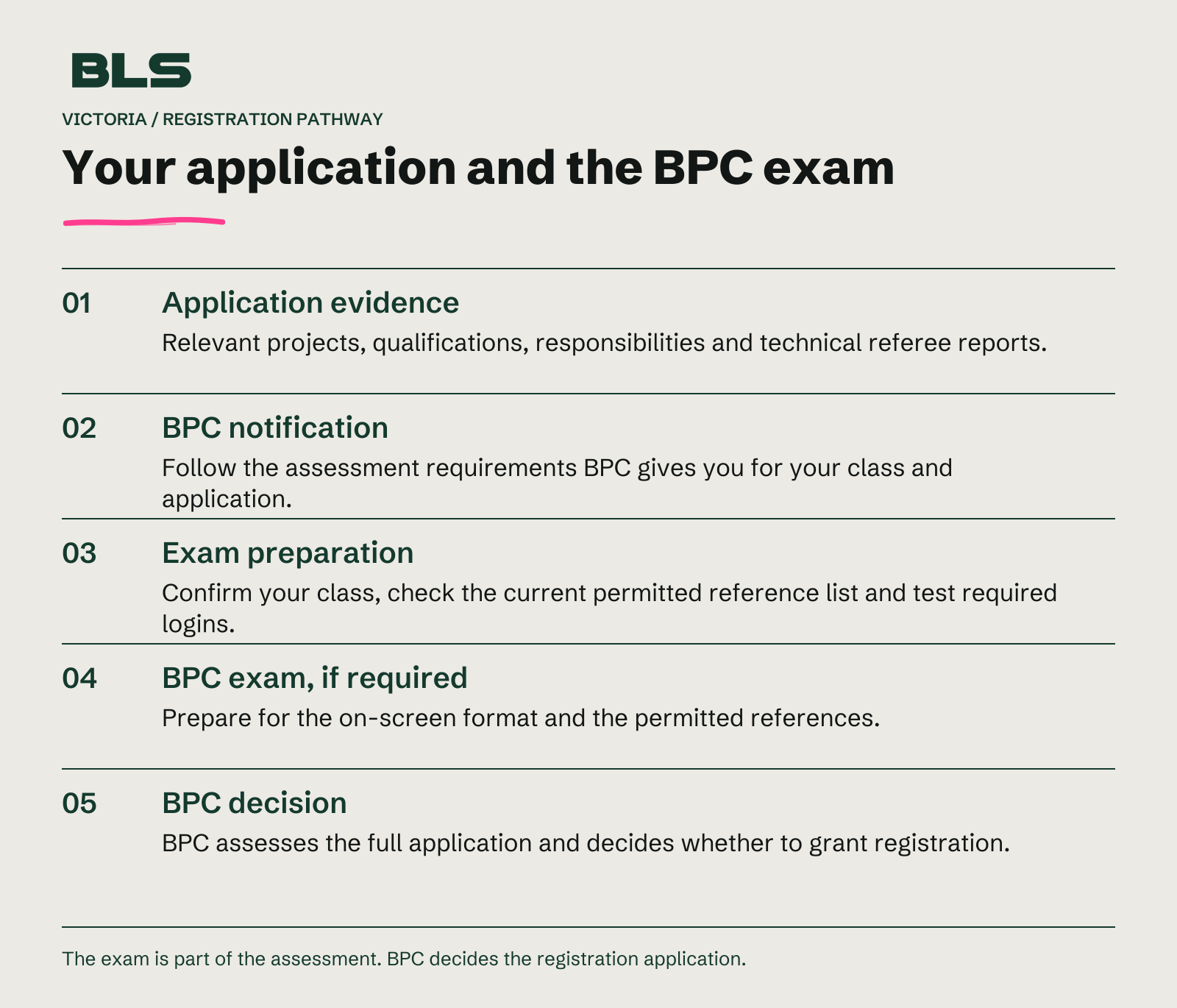
The exam’s only one part of your registration application. If your evidence, referees or class choice are wrong, passing the exam won’t fix it. And if you fail, you need a whole new application to sit again.
BLS coaches clients for the BPC exam: the format, finding your way around the permitted references on screen, and managing your time under pressure. We also help you check the class, identify gaps in your evidence and prepare the forms before you lodge.
The BPC runs the exam and decides your registration. BLS coaches you through the prep.
If you’re still organising the registration application behind the exam, see Victorian domestic builder registration or Victorian commercial builder registration.
Related guides:
- BPC builder exam books: what can you use?
- Victorian builder registration: can your experience support it?
- Do I need to be registered in Victoria?
FAQ
Do you still need a builder’s licence in Victoria?
Yes, though the official name is registration. What most people call a builder’s licence is building practitioner registration with the BPC. The BPC says home owners need a registered builder for domestic building work worth more than $10,000, counting labour, materials and GST. Consumer Affairs Victoria adds that work needing a building permit requires a registered practitioner whatever its value.
How do you become a registered builder in Victoria?
Apply to the BPC in your chosen registration class, meet the qualification and experience requirements, submit your supporting documents, and pass the exam if the BPC asks you to sit one. Under the reformed process this is a single exam rather than a face-to-face interview plus a plan-based exam.
From 19 October 2026 the BPC says some building application processes are online only, through the BPC Portal or its existing online services. Apply and pay online.
What is the BPC builder registration exam?
From January 2026 the BPC began replacing the face-to-face interview and the plan-based exam with a single exam, starting with Domestic Builder (Unlimited) and extending to other classes. It is delivered through Janison-Proctortrack with proctoring and uses multi-format questions (multiple choice, drag and drop, reorder, true/false and image select).
It’s open book: online, you use only the permitted reference materials inside the exam. The BPC’s exams page says hard copy materials are allowed for in-person exams. That page also currently says these exams are being conducted in person at BPC Head Office while technical issues are resolved.
How long is the BPC exam?
The BPC says exams are either 1 or 2 hours. It sets the length based on the class you’re applying for and factors such as your qualifications, building experience, employment history and technical referees. Answers submit automatically when time runs out.
Is the BPC exam open book?
Yes, with conditions. Sitting online, you can only use the permitted reference materials, viewed inside the exam. Your own notes and other printed material, search engines and AI tools are not allowed.
For a transitional period, the BPC is letting applicants who have their own hard copy reference materials sit the exam in person at a BPC location, and it says hard copy materials are allowed for in-person exams. Confirm with the BPC what you can bring.
To use Australian Standards you need your own active subscription or purchased online version, and your login for it during the exam.
What happens if you fail the BPC builder registration exam?
Your application for registration is likely to be refused and you will be notified in writing. You can seek an internal review of that decision. To sit another exam you must lodge a new application for registration.
What if I need adjustments for the exam?
Contact the BPC within three business days of receiving your exam invitation to request reasonable adjustments, by email to [email protected] or on 1300 067 088.
Is the VBA now the BPC?
Yes. On 1 July 2025, the Victorian Building Authority (VBA) became the Building and Plumbing Commission (BPC). That wasn’t just a name change. The BPC brought together the VBA, Domestic Building Dispute Resolution Victoria and the domestic building insurance arm of the VMIA.
Official sources
All facts checked 24 October 2026 against the BPC’s official pages. The BPC updates these pages often. Always confirm with the BPC before acting.
- BPC: Building exams (last updated 28 August 2026)
- BPC: Building exams – frequently asked questions (last updated 30 June 2026)
- BPC: Licensing and registration reforms (30 June 2026)
- BPC: Builder registration applications (notice dated 19 October 2026)
- BPC: Registration requirements and eligibility (last updated 30 June 2026)
- BPC: What is domestic building work? (last updated 6 July 2026)
- BPC: Registration fees (last updated 25 August 2026)
- BPC: New BPC putting consumers first from day one (1 July 2025)
- BPC: Applicant test taker guide (last updated 30 June 2026)
- BPC: Engaging a builder (last updated 30 June 2026)
- Consumer Affairs Victoria: About builders, tradespeople and other building practitioners (last updated 12 December 2025)
- HIA: Building and Plumbing Commission online exams (15 July 2026)